
indroduction
The digital world keeps changing the way businesses reach customers. Its always. Companies have to adapt. New tools and platforms appear all the time. People now expect easy and personalized experiences. Companies that use these tools well can build stronger relationships. Others might fall behind. It’s not about having a website anymore—it’s about being present where customers are. That means media, mobile apps and online search. Every interaction counts. A message, a review, a click—all of these matter. Businesses must stay alert and responsive. The way they connect with customers is no longer one-size-fits-all. It’s personal more immediate and more connected, than ever before.The digital world continues to change how businesses connect with customers. New technologies, changing customer expectations, and evolving online platforms are influencing the way brands promote their products and services. Businesses that want to remain competitive need to understand these changes and adapt their marketing strategies accordingly.
Digital marketing is no longer about running advertisements or posting regularly on social media. It has evolved into something deeper. It’s about building connections with people. It’s about understanding what they need and how they think. It’s about creating value in every interaction. The focus has shifted from being seen to being meaningful. Brands now have to earn trust, not attention. It’s not enough to talk about products. It’s about telling stories that matter. It’s about listening much as speaking. The digital world is no longer a place to broadcast. It’s a place to engage.. That changes everything. It involves understanding customer behaviour, creating useful content, building trust, and delivering the right message to the right audience. As competition increases, businesses must find effective ways to reach potential customers and maintain strong relationships with existing ones.
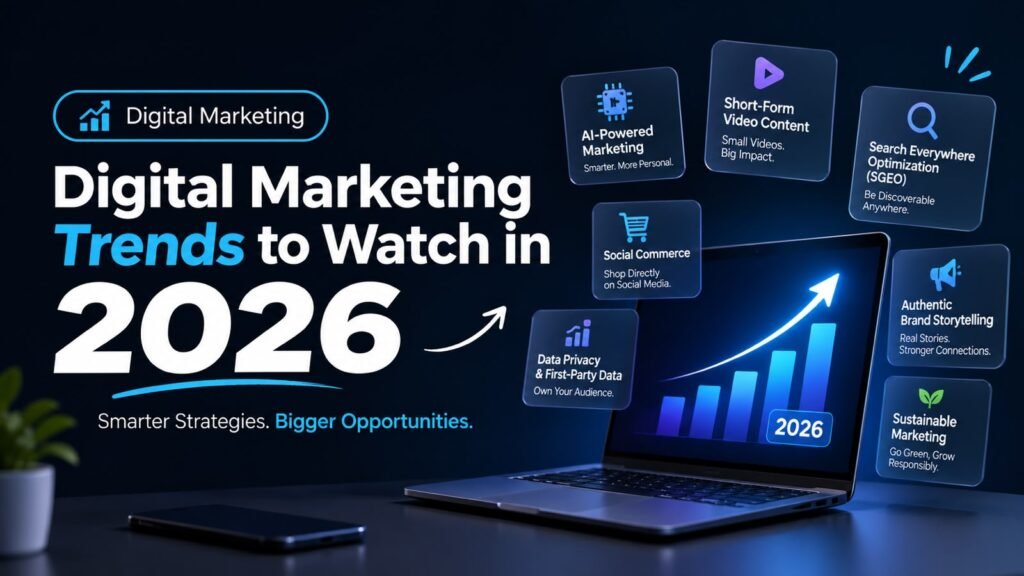
In 2026, several important developments are shaping the marketing industry. From artificial intelligence and personalised experiences to short-form videos and changing search habits, these developments offer new opportunities for businesses of different sizes.
Understanding the latest digital marketing trends can help brands make better decisions, improve their online presence, and develop more effective campaigns. Let’s explore the key trends businesses should watch in 2026.
1. Artificial Intelligence in Digital Marketing
Artificial intelligence has become an important part of modern marketing. Businesses are using AI-powered tools to understand customer behaviour, analyse marketing data, generate content ideas, and improve campaign performance.
These tools can help marketing teams complete repetitive tasks more efficiently. For example, AI can assist with identifying audience interests, suggesting content topics, and analysing the results of advertising campaigns.
However, technology alone cannot create a successful marketing strategy. Businesses still need human creativity, industry knowledge, and an understanding of their customers. Content that feels personal and relevant is more likely to connect with readers than generic messages.
In 2026, businesses should focus on using AI as a supporting tool rather than relying on it for every marketing decision. Combining technology with human judgement can help brands create more useful and engaging experiences
2. Personalised Customer Experiences
Customers increasingly expect brands to understand their needs and preferences. They are more likely to engage with messages that reflect their interests than with advertisements that feel irrelevant.
Personalisation involves adapting marketing messages, recommendations, and customer experiences to different audience groups. For example, an online store may recommend products based on previous purchases, while a service-based business may share information relevant to a customer’s interests.
Businesses can use customer feedback, website analytics, and purchase patterns to understand their audiences better. This information helps marketers develop messages that are more relevant to specific customer groups.
Nevertheless, personalisation should respect customer privacy. Businesses must handle personal information responsibly and follow applicable data protection requirements.
A thoughtful approach to personalisation can strengthen customer relationships, improve engagement, and encourage repeat purchases.
3. Short-Form Video Content Continues to Grow
Short-form videos have become a popular way for businesses to communicate with online audiences. Platforms such as Instagram, YouTube, and TikTok allow brands to share information through quick, engaging videos.
These videos can introduce products, explain services, answer common questions, and provide a behind-the-scenes look at a business. They also give smaller brands an opportunity to communicate their personality without requiring a large production budget.
Successful video content does not always need expensive equipment or complicated editing. Clear messaging, good lighting, and a strong opening can make a difference.
Businesses should focus on creating videos that offer genuine value instead of following every viral trend. Educational clips, customer experiences, product demonstrations, and practical tips can help attract the right audience.
Including short-form videos in a broader digital marketing strategy can improve brand awareness and create more opportunities for customer interaction.
4. Search Engine Optimisation Is Evolving
Search engine optimisation remains important for businesses that want people to discover their websites through search engines. However, SEO involves more than adding keywords to web pages.
Search engines aim to provide useful and relevant answers to users. Businesses should therefore create content that addresses real questions, explains topics clearly, and demonstrates experience and expertise.
Technical performance also matters. Websites should load efficiently, work properly on mobile devices, and provide a straightforward browsing experience.
Local businesses can benefit from maintaining accurate business information, collecting genuine customer reviews, and creating content relevant to their service areas.
As search experiences continue to evolve, businesses should also consider how their content can answer specific questions directly. Clear headings, well-organised information, and reliable sources can make content easier for both readers and search systems to understand.
Rather than chasing every new SEO technique, businesses should focus on publishing useful content and maintaining a technically sound website.
5. Social Media Marketing Is Becoming More Community-Focused
Social media is no longer simply a place for businesses to publish promotional messages. It also provides an opportunity to build relationships, respond to customer concerns, and develop a community around a brand.
Audiences often appreciate businesses that communicate naturally and respond to comments and questions. Consistent interaction can make a brand feel more approachable and trustworthy.
In 2026, busines sess hould consider creating content that encourages meaningful conversations. Polls, question-and-answer sessions, informative posts, and customer stories can help audiences participate rather than passively consume content.
It is also important to select platforms based on the target audience. A business does not need to maintain an active presence on every social network. Focusing on the platforms that suit its customers and goals can make marketing efforts more effective.
A community-focused approach helps businesses develop stronger connections and understand what their customers actually value.
6.Influencer Marketing Is Shifting Towards Authenticity
Influencer marketing allows businesses to introduce their products and services through creators who have established relationships with specific audiences.
Although large influencers can offer broad exposure, smaller creators may provide access to more focused communities. Their content can feel more personal, especially when their audience genuinely trusts their recommendations.
Businesses should look beyond follower counts when selecting influencers. Audience relevance, engagement quality, content style, and credibility are also important considerations.
For example, a local fitness business may benefit more from collaborating with a relevant fitness creator than from partnering with a celebrity whose audience has little interestin its services.
Brands should establish clear campaign goals and evaluate results using suitable metrics, such as website visits, enquiries, conversions, and audience engagement.
Authentic partnerships can help businesses reach relevant customers while building credibility over time.
7. Content Marketing Is About Providing Real Value
Content marketing remains a useful way to educate audiences, answer questions, and build trust. However, publishing large amounts of content without a clear purpose is unlikely to produce meaningful results.
Customers often search online for solutions before deciding which product or service to choose. Businesses can support this process by publishing helpful blog posts, guides, case studies, videos, and frequently asked questions.
For example, a digital agency might publish an article explaining how local SEO works or how businesses can improve their social media engagement. Such content can help potential customers understand a problem before considering professional services.
Quality should remain the priority. Articles need clear explanations, relevant examples, accurate information, and a structure that makes them easy to read.
Businesses should also update older content when information becomes outdated. This helps maintain accuracy and keeps useful resources relevant to readers.
A well-planned content strategy can support organic visibility and help establish a business as a knowledgeable resource in its industry.
re effectively.
9. Mobile-First Marketing Is Essential
Many people use smartphones to search for information, compare products, watch videos, and communicate with businesses. This makes the mobile experience an important consideration for modern brands.
A website that looks attractive on a desktop computer may still create problems on a smaller screen. Difficult navigation, tiny text, slow loading times, and complicated forms can discourage visitors from continuing.
Businesses should test their websites on different mobile devices and make sure essential information is easy to find. Contact details, service descriptions, calls to action, and enquiry forms should be accessible without unnecessary effort.
Mobile-friendly content also includes readable text, appropriately sized images, and videos that display correctly.8. Data-Driven Marketing and Better Measurement
Marketing decisions become more effective when businesses understand what is working and what needs improvement.
Data-driven marketing involves using information such as website traffic, engagement, enquiries, conversion rates, and advertising costs to evaluate performance.
For instance, a business may receive many website visitors but very few enquiries. By examining user behaviour and the website’s enquiry process, marketers may identify issues such as unclear service descriptions, slow loading times, or complicated forms.
It is important to choose metrics that reflect business objectives. Social media likes may indicate engagement, but they do not necessarily show whether a campaign is generating sales.
Businesses should regularly review campaign results and use those findings to improve future decisions.
Responsible data collection is equally important. Companies should respect customer privacy and ensure their tracking practices comply with relevant laws and platform requirements.
By connecting marketing activity with measurable business outcomes, companies can use their budgets mo
A smoother mobile experience can help visitors explore a business and complete important actions, such as making an enquiry or purchasing a product.
10. Conversion Rate Optimisation Is Gaining Attention
Attracting visitors is only one part of online marketing. Businesses also need to help those visitors take meaningful actions.
Conversion rate optimisation, commonly known as CRO, focuses on improving the percentage of website visitors who complete a desired action. This could include submitting a contact form, booking a consultation, registering for an event, or purchasing a product.
Small improvements can sometimes make a significant difference. Clearer headlines, stronger calls to action, simpler forms, and more informative service pages can make it easier for visitors to understand what to do next.
Businesses can evaluate different page layouts and messages to learn which approaches work best for their audiences.
However, changes should be based on evidence rather than assumptions. Analysing user behaviour and gathering feedback can reveal where potential customers encounter difficulties.
When conversion optimisation is combined with a well-planned digital marketing strategy, businesses can make better use of the traffic they already receive.
11. Email Marketing Continues to Build Customer Relationships
Despite the popularity of social media, email remains a useful communication channel for many businesses. It allows brands to share updates, provide helpful information, introduce new services, and maintain relationships with interested customers.
A successful email campaign begins with a relevant audience. Businesses should obtain appropriate permission, provide clear subscription information, and make it easy for recipients to unsubscribe.
Personalised subject lines, useful content, and well-organised messages can improve the reader’s experience. Businesses should avoid sending excessive promotional emails that offer little value.
Email marketing can also support customer retention by sharing educational resources, product updates, and relevant offers.
Rather than focusing only on the number of emails sent, marketers should monitor engagement, click-through rates, conversions, and unsubscribe rates.
When used thoughtfully, email marketing can help businesses maintain communication with customers beyond social media platforms.
12. Building Trust Through Authentic Brand Communication
Consumers have access to countless brands and advertisements online. As a result, trust can play an important role in purchasing decisions.
Businesses can strengthen credibility by communicating honestly, providing accurate information, responding to feedback, and maintaining consistency across their marketing channels.
Customer reviews, detailed case studies, transparent pricing information, and genuine testimonials can help potential customers understand what a business offers.
Brands should avoid making unrealistic promises or presenting misleading results. Instead, they should explain their services clearly and set reasonable expectations.
Showing the people behind a business can also make communication feel more personal. Behind-the-scenes content, team introductions, and explanations of the working process can help audiences understand the organisation.
Authenticity is not simply a marketing technique. It requires businesses to ensure that their public messages reflect the experiences they actually deliver.
How Businesses Can Prepare for Digital Marketing Trends in 2026
Following every new trend can waste time and resources. Businesses should select strategies based on their objectives, budgets, and customers.
Start by reviewing your existing marketing performance. Identify which channels generate meaningful enquiries, which content attracts the right audience, and where customers encounter difficulties.
Next, choose a small number of priorities. A local business might focus on local SEO, customer reviews, and short-form videos, while an online retailer may prioritise personalised recommendations, email campaigns, and conversion optimisation.
Set measurable goals before launching a campaign. These could include increasing qualified enquiries, improving website conversions, or generating more relevant organic traffic.
Finally, review results regularly and make adjustments when necessary. Marketing strategies should evolve as customer needs and business priorities change.
Working with an experienced agency can also help businesses identify opportunities, develop a structured plan, and use available resources more efficiently.
Conclusion
The marketing landscape continues to evolve as technology advances and customer expectations change. Artificial intelligence, personalised experiences, short-form videos, SEO, influencer partnerships, and data-driven decisions are all important developments for businesses to understand in 2026.
However, success does not come from following every trend. It comes from choosing the right strategies, understanding the target audience, creating useful content, and measuring results consistently.
Businesses that combine innovation with clear communication and genuine customer value can build stronger relationships and improve their online presence.
Uthenticity At MarketRibes, understanding changing marketing practices is an important step towards helping businesses make informed decisions about their digital growth. By focusing on relevant strategies and measurable outcomes, brands can adapt to a changing environment and create more meaningful connections with their audiences.
The best approach is to remain curious, keep learning, and focus on the marketing activities that deliver real value to your business.